Executive Summary
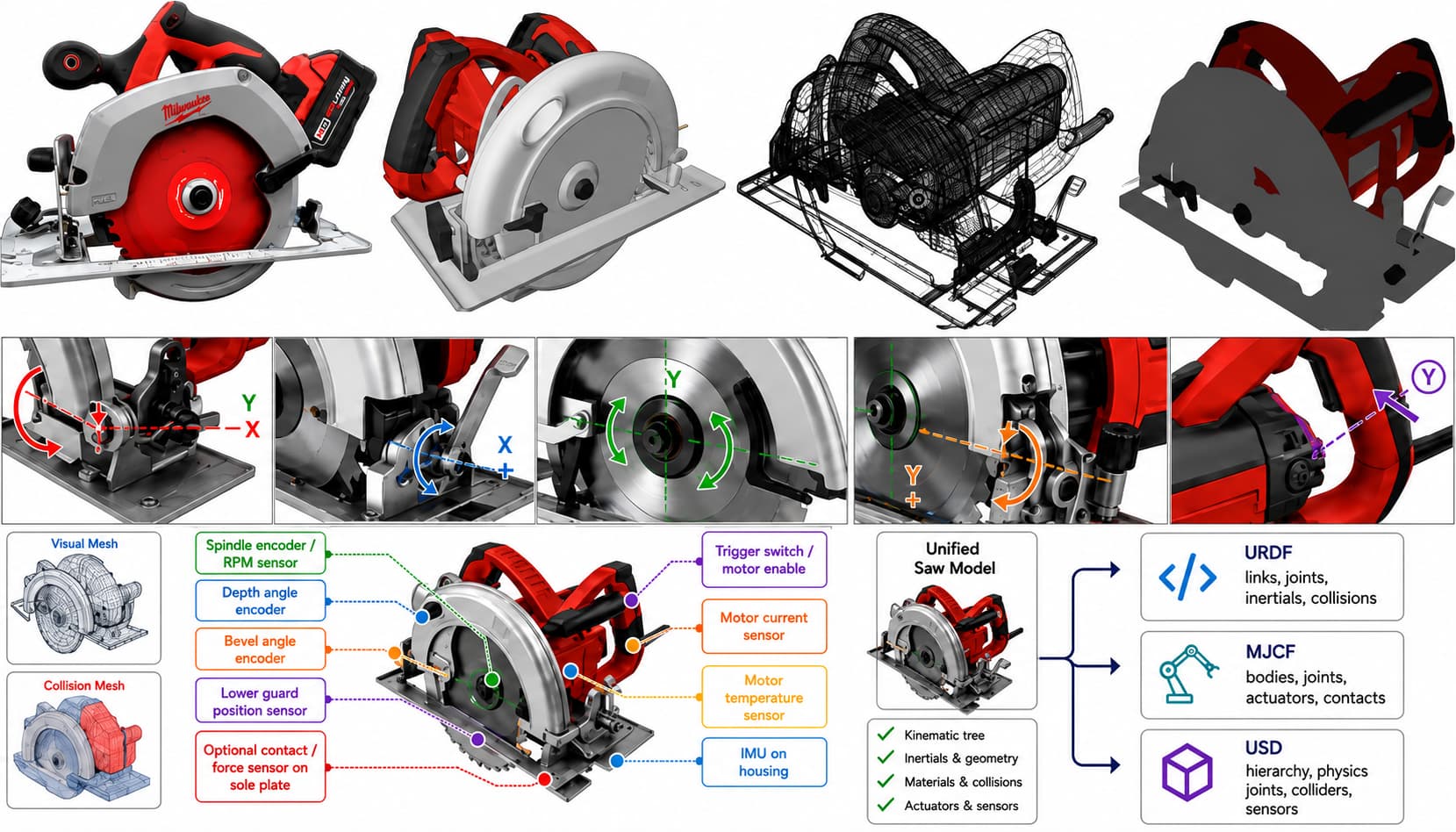
Building simulation ready models of construction power tools has traditionally required separate manually tuned assets for each physics engine. Humano Tool Modelling pipeline addresses this by delivering fully automated format-agonistic workflow that transforms CAD assemblies and photogrammetry scans of real tool into high fidelity physics-aware digital assets deployable in Isaacsim, MuJoCo and ROS2/Gazebo without rework.
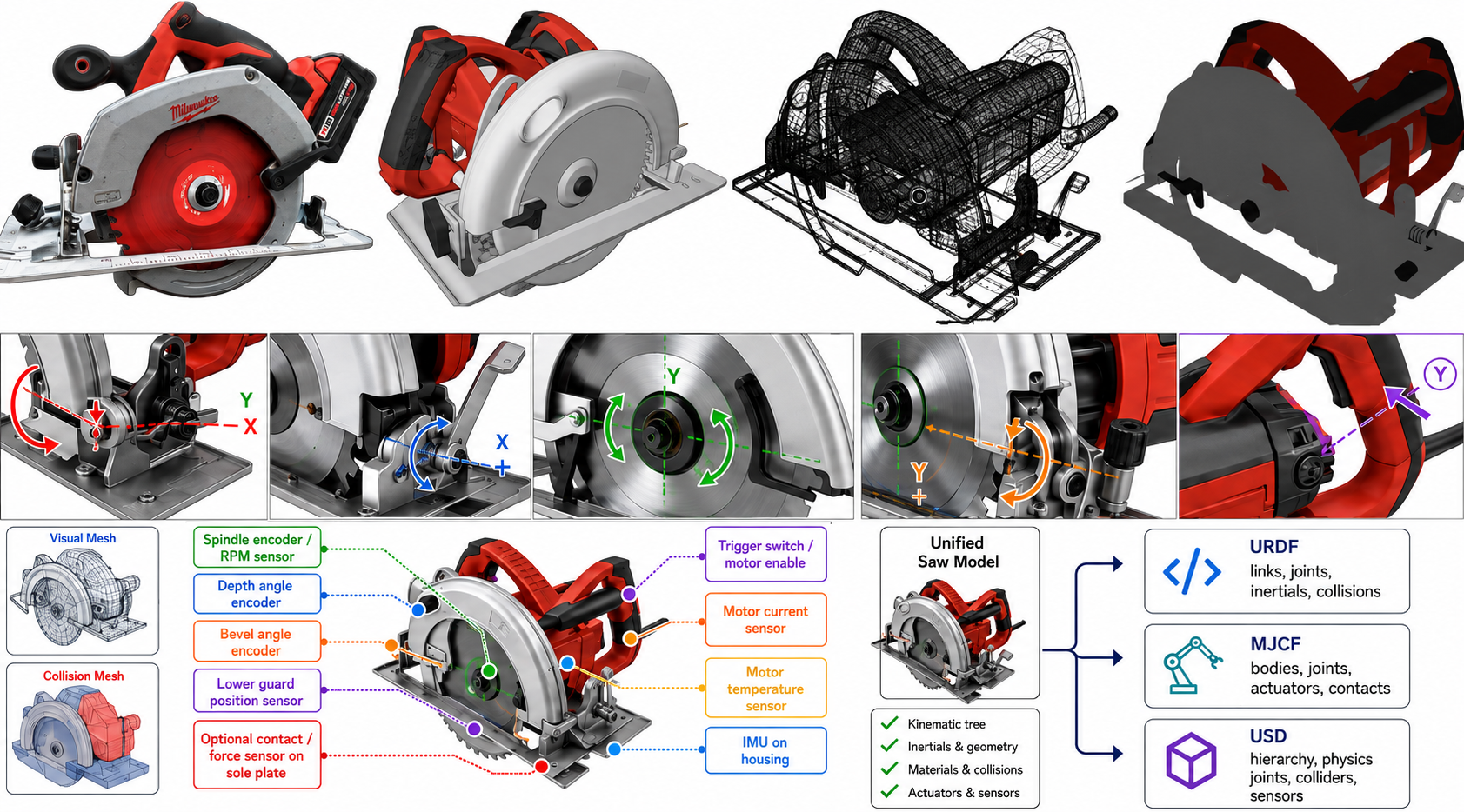
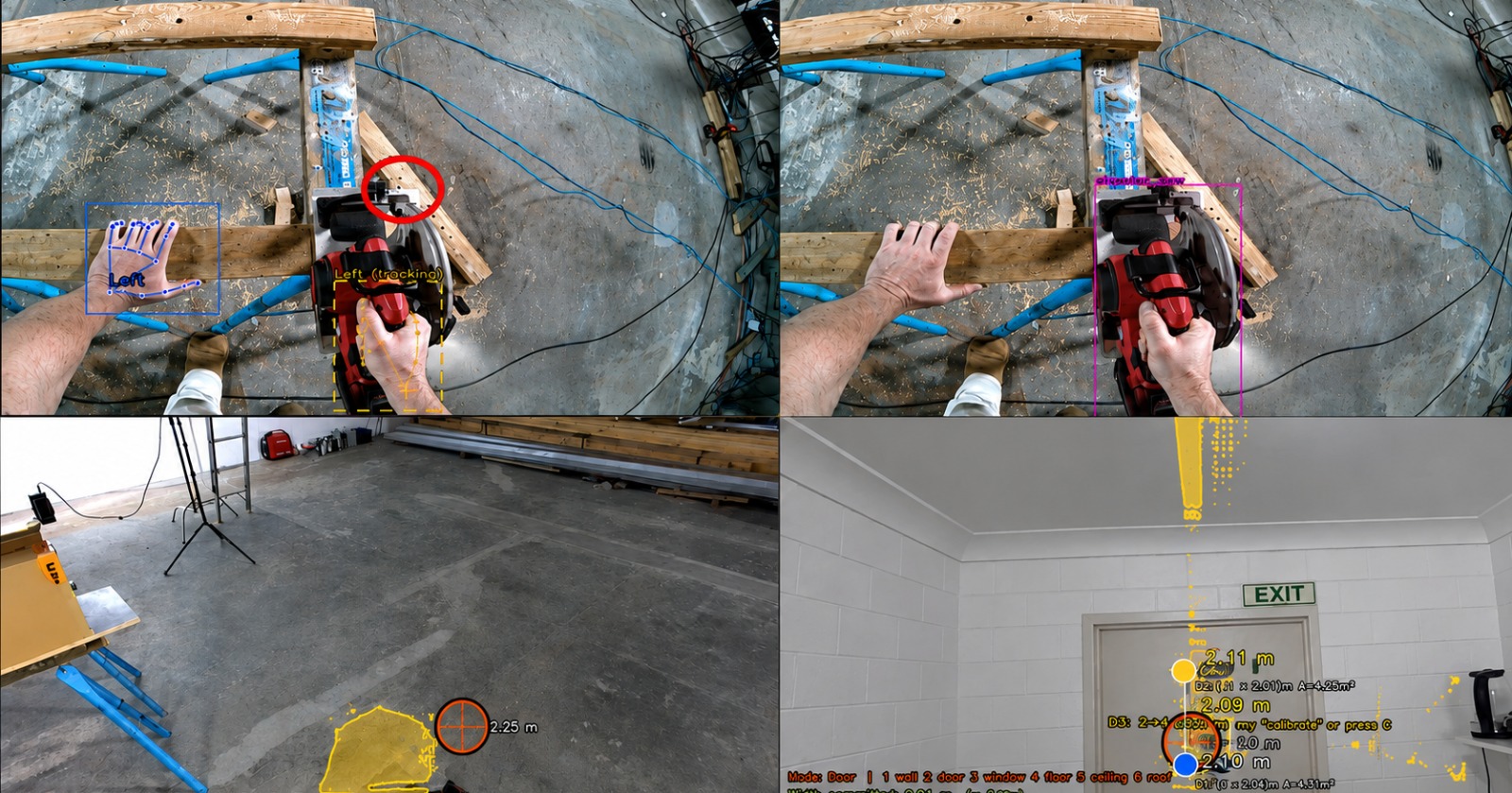
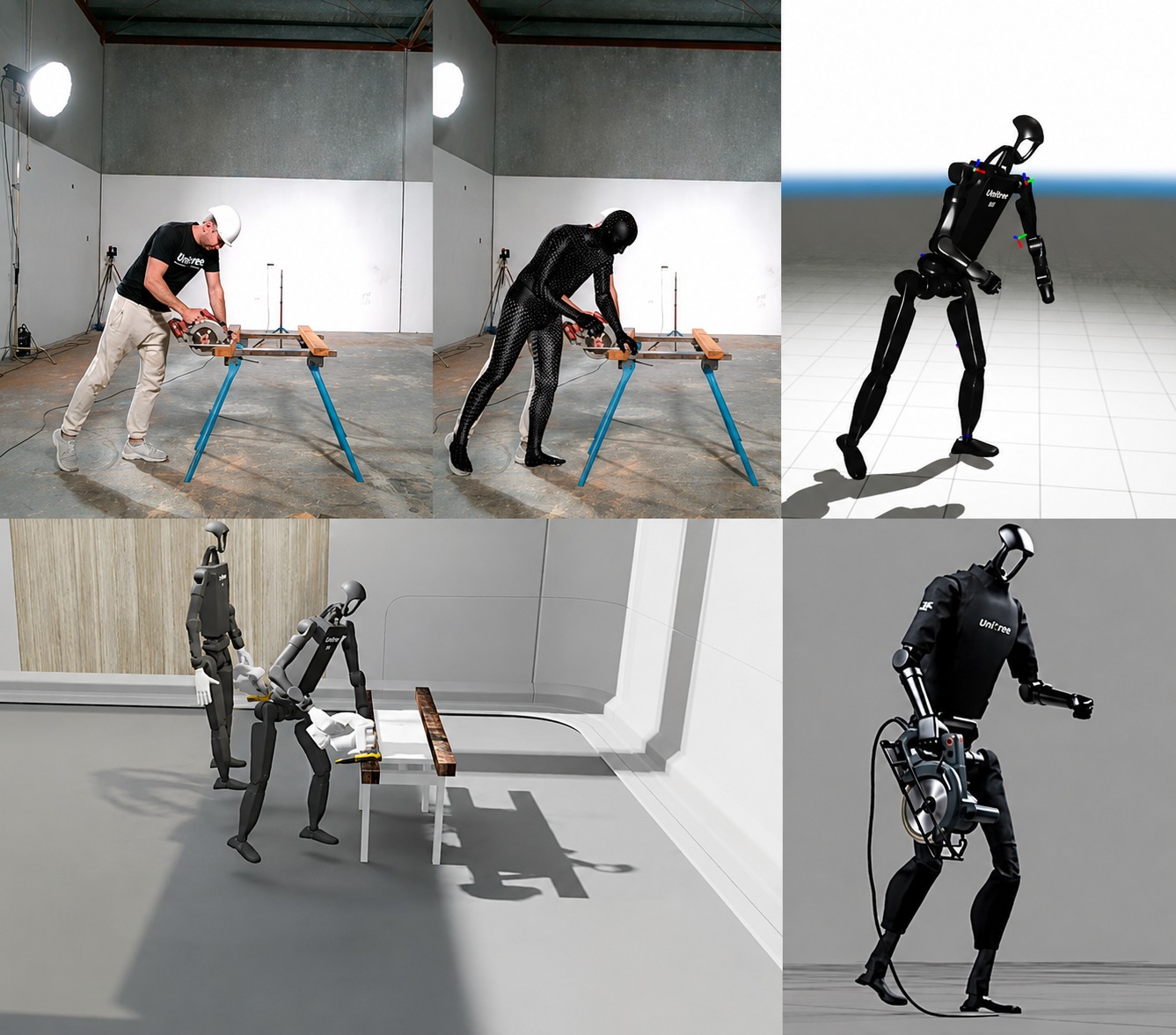
Our pipeline is modular digital asset infrastructure stack that comprises of source ingestion layer, geometry processing backend, physics property alignment model, sensor simulation layer and multi-format export bridge. The pipeline is relevant to robot learning for construction automation, where sensor-rich and mechanism-built tool models are essential for behaviour cloning to train manipulation policies for dependable sim-to-real transfer.
System Specifications
The pipeline starts with [1] dual-source ingestion that accepts two primary source types i.e, CAD assemblies that provide exact part geometry, assembly hierarchy and mass properties from native materials and photogrammetry scan that provide real surface details, worn geometry and texture data that is normally unable in CAD.
Both sources are normalized to common coordinate frame, physical scale and mesh watertightness standard before downstream processing. [2] Geometry module maintains strict separation between visual and collision representations. Visual meshes preserve full surface details for rendering fidelity. Collision meshes are generated targeting fewer convex hulls per body.
[3] Each tool receives an explicit joint tree that reflects its mechanical degrees of freedom. Joint limits, damping, friction and spring parameters are specified per joint and validated against manufacturer datasheets where available. [4] Inertia tensor and mass properties are derived directly from CAD rather than estimated from mesh volume to obtain sub-percent accuracy for dynamic simulation.
[5] Sensor layer attaches virtual sensor models to tool joint tree. Sensor noise parameters are calibrated against measurements from instrumented physical tools. [6] All tool properties are stored in canonical YAML intermediate that acts as a source of truth. Tanspiler script converts it to each target format i.e., MJCF, URDF and USD. Per-format override layer allows physics parameters with no cross-format equivalent to be specified individually without modifying canonical intermediatory.